
Why Transformative Coaching Is an Investment, Not a Cost (And How It Multiplies Results)

Most people evaluate coaching like an expense. High performers treat it like infrastructure. In a world driven by AI, data, and constant decision pressure, the real bottleneck isn’t access to information, it’s how you operate inside of it. This article breaks down why traditional coaching often fails, and how transformative coaching shifts identity, alignment, and execution to create compounding results across performance, financial outcomes, and capacity.
Most people still evaluate coaching like it’s a cost.
That’s the problem.
Because if you’re operating in today’s environment of tech, AI, constant decision pressure, you’re not lacking information.
You’re drowning in it.
And yet, most people are still stuck.
Not because they don’t know what to do.
Because of how they operate.
The Real Bottleneck Isn’t Knowledge
There was a time when coaching meant access.
Access to:
- experience
- perspective
- better thinking
People paid for that.
And they still do.
But here’s what hasn’t changed:
Access doesn’t equal execution.
You can have:
- the tools
- the models
- the data
- the strategy
…and still stall.
Because execution isn’t a knowledge problem.
It’s:
- identity
- alignment
- decision-making under pressure
That’s where most coaching misses.
It stays at the surface.
Information in.
Hope something sticks.
Coaching as a Cost vs Coaching as an Asset
This is where the shift happens.
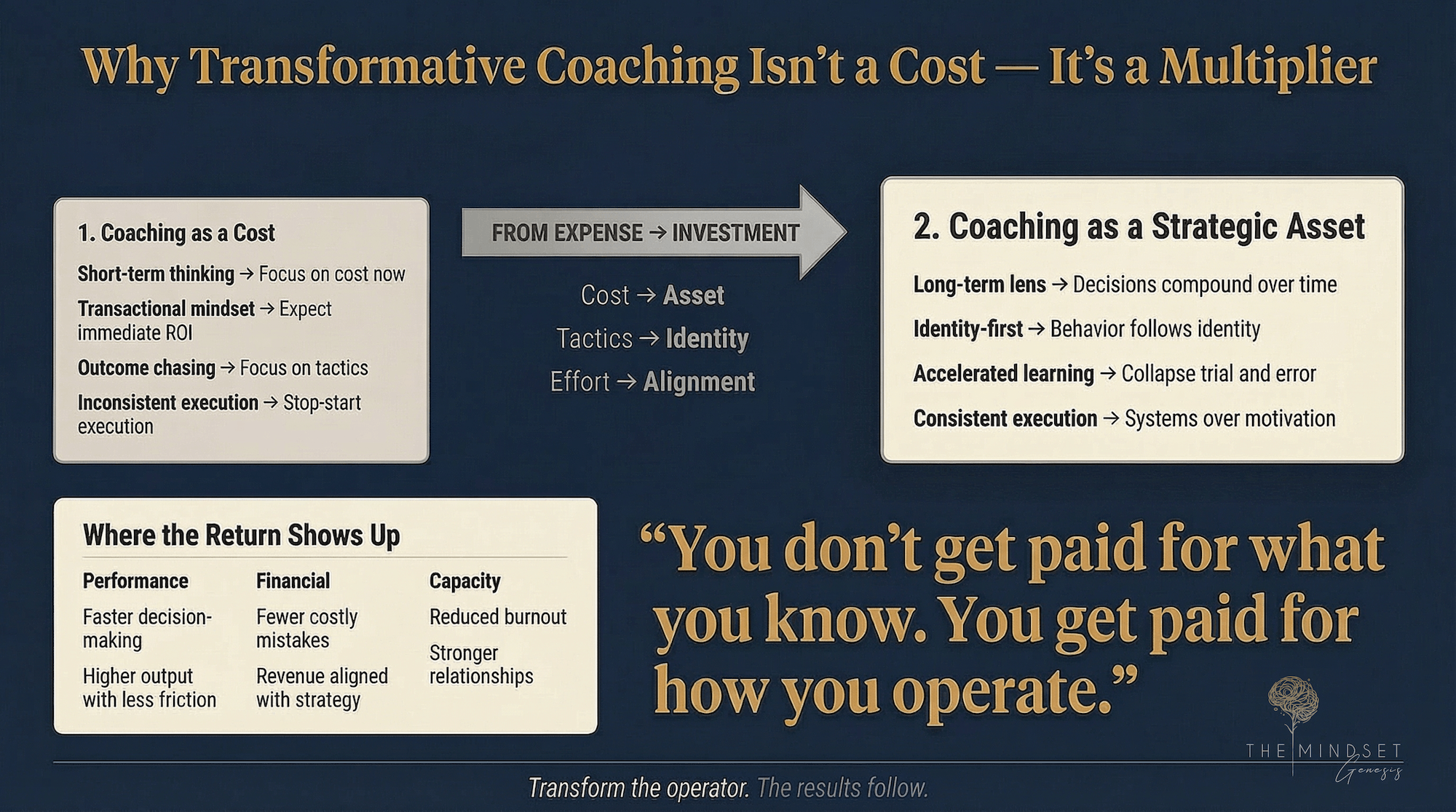
If you see coaching as a cost, you evaluate it like this:
- What does it cost me right now?
- What immediate ROI will I see?
- Can I figure this out myself?
That mindset leads to:
- short-term thinking
- stop-start execution
- constant resets
Nothing compounds.
If you see coaching as an asset, everything changes.
You’re not buying information.
You’re upgrading how you operate.
- Cost → Asset
- Tactics → Identity
- Effort → Alignment
Now decisions compound.
Execution stabilizes.
Clarity increases.
Why Most Coaching and Courses Fall Short
Let’s call it what it is.
Most coaching doesn’t work because it stays comfortable.
- Generic frameworks
- Motivational energy
- Surface-level accountability
It sounds good.
It doesn’t hold under pressure.
Courses are worse.
They give you:
- more inputs
- more ideas
- more things to “try”
But no real change in how you think, decide, or execute.
So you end up with more knowledge…
…and the same patterns.
Execution Is the Only Thing That Pays
You don’t get paid for what you know.
You get paid for how you operate.
That shows up in three places:
Performance
- Faster, cleaner decisions
- Higher output with less friction
Financial
- Fewer costly mistakes
- Revenue aligned with actual strategy
Capacity
- Less burnout
- Stronger relationships
- More control over your time and energy
This is the real ROI.
Not theory.
Not potential.
Actual output.
Where Transformative Coaching Actually Works
The difference isn’t more sessions.
It’s depth.
Real coaching isn’t about telling you what to do.
It’s about recalibrating:
- how you think
- how you make decisions
- how you execute when it matters
That’s where identity shifts.
That’s where alignment happens.
That’s where friction drops.
And that’s where things start compounding.
The Investment Conversation Is Backwards
People ask:
“Is coaching worth it?”
Wrong question.
The real question is:
What is your current way of operating costing you?
- Delayed decisions
- Missed opportunities
- Inconsistent execution
- Energy leaks you haven’t identified
That cost compounds too.
Just in the wrong direction.
The Bottom Line
Coaching isn’t an expense.
It’s infrastructure.
If it’s done right.
Because at the end of the day:
You don’t need more information.
You need to operate at a higher level.
That’s the multiplier.
Execution Challenge
Look at your last 30 days.
Where did you:
- hesitate on decisions?
- overthink instead of act?
- start and stop instead of follow through?
That’s not a knowledge gap.
That’s how you’re operating.
Fix that and everything changes.
If this hit, we should talk.
Not about coaching. About how you’re operating, and where it’s breaking down.
Disclaimer: This article represents a collaborative effort between human creativity and advanced AI technology. The content was not merely written and pasted; it was intricately engineered with the assistance of OpenAI and Ideogram, which played a pivotal role in shaping and refining the ideas, structure, and expression found within.


.svg)

Las Vegas
Nevada, 89107


